Appointment Letters Under the New Labour Codes: What's Urgent and What Isn't
Every new hire now needs an appointment letter in a prescribed format. The panic about reissuing letters to existing staff is overstated. What to fix, and what your HR and payroll software should handle.
Every worker you hire from now needs a written appointment letter, in a format the government has prescribed. Permanent, fixed-term, contract, daily wage — no exceptions, and no headcount threshold.
That part is settled.
What is less settled is what this means for the people already working for you. If you run a 40-person factory where half the workforce joined years ago on a handshake, you have probably read that you are sitting on an urgent compliance problem.
You are probably not. At least, not in the way it is being described.
What the rule actually says
Rule 6 of the Occupational Safety, Health and Working Conditions (Central) Rules, 2026 sets the requirement. Every employer must issue a detailed appointment letter to every employee before they join. The government notified these final rules on 8 May 2026. They operationalise the four Labour Codes, in force since 21 November 2025.
Two things changed. The obligation now covers every company, whatever its size or sector. Earlier it applied mainly to scheduled employments and larger formal setups. The rules also prescribe the format and particulars the letter must contain.
The second point is the one people miss. It is no longer enough to have issued a letter. The letter has to say what the rules require it to say.
The Union Minister for Labour and Employment put it plainly in Parliament in February 2026: an appointment letter must be given to every youth who gets a job, under all circumstances.
What is urgent: your next joining
This part is unambiguous. Anyone joining your business from now needs a compliant appointment letter, issued before they start.
There is no minimum headcount and no salary threshold. It applies to permanent, fixed-term and contract workers alike. Daily wage workers and those in informal employment are covered too.
For a business running mixed employee types, that last sentence is the one that matters. Your office staff have probably always received letters. Your contract workers, seasonal hires and loaders may never have. Under the Codes they are covered identically.
What is not urgent: the people already on your rolls
Here is where most of the coverage overreaches.
Legal guidance on implementation has been consistent. The immediate step is to onboard employees hired after the effective date using the prescribed appointment letter form. Other documentation can be brought into line gradually. That includes muster rolls, wage registers and overtime records.
There is also a transitional cushion. The repeal and savings provisions across all four Codes give employers temporary relief from penalties while implementation is incomplete. That relief is not uniform. Risk varies by state, depending on whether the applicable rules and forms have been notified there. Where a rule or form has not been notified, employers are unlikely to be penalised for continuing existing practice.
So the honest position is this. Reissuing letters to forty existing employees is worth planning. It is not worth panicking about this month, and anyone telling you otherwise is selling urgency.
Your next hire is the real deadline.
The thing worth checking this week
If you do one thing after reading this, make it this one. Look at the appointment letter template you currently use, whether it sits in a Word file or inside your HR and payroll software.
Most templates in circulation were written before the Codes. They may not carry the prescribed particulars, and they almost certainly do not reflect the revised definition of wages under the Code on Wages.
That template is what your next joiner will receive. An outdated format issued to a new employee is a live problem, in a way that a 2019 employee's missing letter currently is not.
Fix the template first. Everything else follows from it.
An offer letter is not an appointment letter
Many small businesses treat these as the same document. They are not.
An offer letter is a conditional proposal issued before someone joins. It usually states CTC, joining date and designation.
An appointment letter is the employment contract itself. It is issued on or after joining. It covers the full terms: wages, working hours, leave, notice period, employment classification and statutory benefits. Only this document carries the weight of a contract.
If your files hold offer letters and you assumed the requirement was met, check what those documents actually say.
What the letter has to carry
Confirm the prescribed particulars against the official notification. This is the part that determines compliance. Broadly, a compliant letter draws on:
- Personal and contact details
- Date of joining, designation and department
- Employment classification — permanent, fixed-term or contract
- Wage structure, aligned with the revised wage definition
- Working hours and shift pattern
- Leave entitlement under the policy applying to that employee
- Notice period
- Reporting relationship
Individually, none of these is difficult. Collectively, for a business with several employee types, they are the reason this becomes a project rather than a task.
Where HR and payroll software fits
The drafting is not the hard part. The assembling is.
For most businesses this size, that information sits in four places. A joining file, a salary sheet, an attendance register, and one person's memory of who reports to whom. Pulling it together for one new joiner is manageable. Doing it repeatedly and correctly, across several employee types, is where HR and payroll software earns its place.
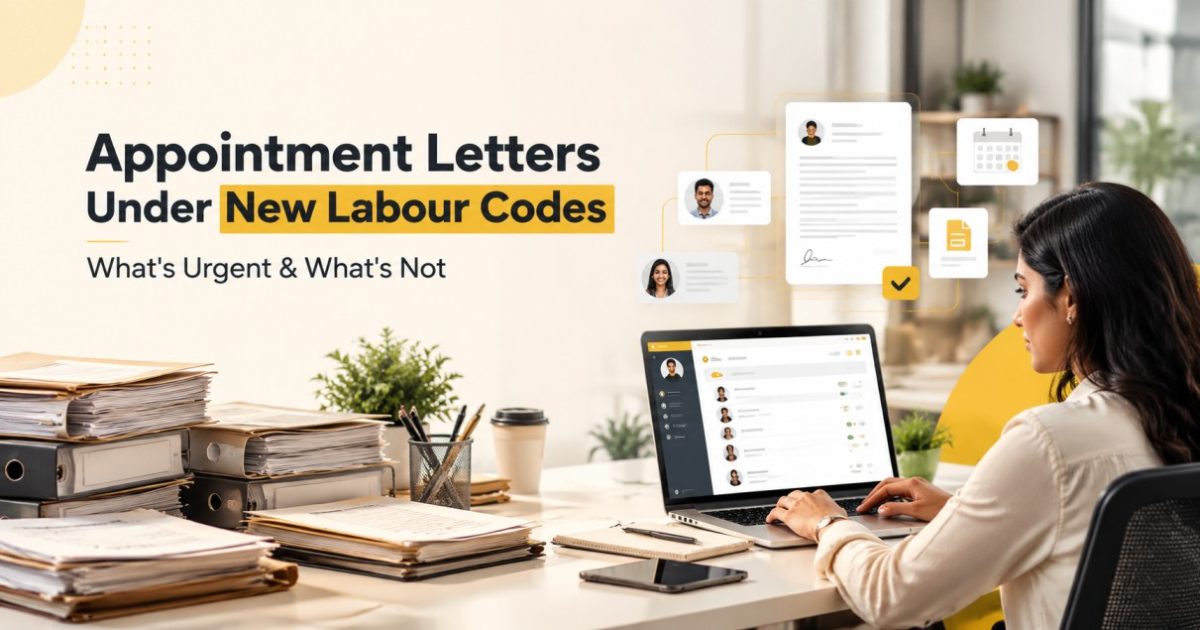
Employee records in one place. MYP Payroll holds personal and contact details, employment and salary information, department, designation, reporting hierarchy and documents against each employee. The data a letter needs is already assembled.
Templates you control. MYP supports predefined HR document templates and custom templates you define yourself. The prescribed particulars are specific. So an editable template matters more than a fixed format somebody else decided, which is the main thing to check before choosing any HR and payroll software for this.
Bulk generation when you do align existing staff. Letters can be generated in bulk from employee data rather than one at a time. When you work through existing employees gradually, this is the difference between an afternoon and a fortnight.
Different groups, different terms. Office staff, shift workers, field employees and contract workers each carry their own employment types, wage structures, leave rules and shift patterns. So each group's letters reflect that group's real terms. No single template stretched to cover everyone.
Documents stay with the employee. MYP holds generated documents against the employee record, so a letter remains retrievable instead of sitting in a folder somebody has to find.
A sensible order of work
- Update your appointment letter template to the prescribed format
- Issue it to every new joiner from now, before they start
- Audit who currently has a letter, who has only an offer letter, and who has nothing
- Clean up the underlying employee data
- Work through existing employees in batches, by employee group
- Store each letter against the employee record
Steps one and two are this month's work. Steps three to six are this quarter's.
Please note: this article describes the operational impact of the appointment letter requirement and is not legal advice. Implementation varies by state, and the transitional position is still developing. Confirm the prescribed format and how these rules apply to your workforce with a labour law advisor or your CA, and against the official notifications published by the Ministry of Labour and Employment at labour.gov.in.
Frequently Asked Questions
1. Are appointment letters mandatory for all employees in India now?
Yes. Under Rule 6 of the Occupational Safety, Health and Working Conditions (Central) Rules, 2026, every employer must issue a detailed appointment letter to every employee before they join. The requirement applies regardless of the organisation's size or sector, and covers permanent, fixed-term and contract workers.
2. Do I have to reissue appointment letters to employees who already work for me?
Implementation guidance has focused on new hires first, with other employment documentation aligned to the revised formats gradually. The repeal and savings provisions in the Labour Codes provide transitional relief from penalties while implementation remains incomplete. The position also varies by state. Employers should confirm their specific obligation with a labour law advisor rather than assuming either urgency or exemption.
3. Do contract and daily wage workers need appointment letters?
Yes. The requirement carries no minimum headcount or salary threshold, and extends to daily wage workers and workers in informal employment alongside permanent and fixed-term employees.
4. Is an offer letter the same as an appointment letter?
No. An offer letter is a conditional proposal issued before joining, usually covering CTC, joining date and designation. An appointment letter is issued on or after joining and functions as the employment contract, covering the full terms of employment. Only the appointment letter is legally binding as a contract.
5. How can HR and payroll software issue appointment letters in bulk?
Bulk issuance depends on complete employee records: designation, department, date of joining, wage structure, employment classification, working hours, leave entitlement and reporting relationship. MYP Payroll holds these against each employee record. It supports predefined and custom HR document templates with bulk generation, so letters can be produced by employee group rather than drafted one at a time.
About MYP Payroll
MYP Payroll is HR and payroll software built for Indian businesses with mixed teams — office staff, shift workers, field employees and contract labour on different rules, in one system. It holds complete employee records, supports predefined and custom HR document templates with bulk generation, and captures attendance through biometric integration, file import, Excel/CSV upload, location-based check-in and web check-in. PF, ESI, TDS and income tax are calculated within the payroll run, with payslips, salary registers and Form 16 generated for download. Assisted setup and data migration are included at no additional cost.
Getting your employee records in order first? That is the right sequence. MYP is HR and payroll software built for Indian businesses with mixed teams. Book a demo on WhatsApp and we'll show you what MYP holds against each employee, and how documents are generated by employee group.