Payroll Software: Understanding Gross Salary, Net Salary and CTC Calculations
Confused about CTC, gross salary and take-home pay? Learn the key differences, salary calculation methods and how Payroll Software simplifies payroll management for Indian businesses.
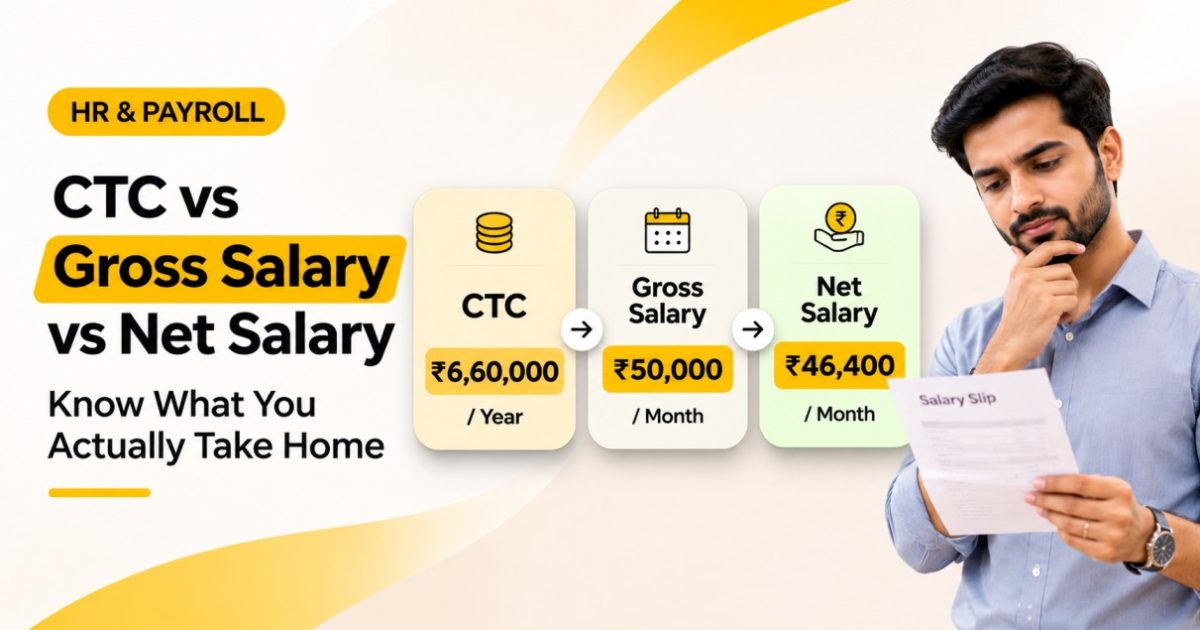
Your CTC (Cost to company) is mentioned in your Offer Letter as 6.6 lakhs per year. However, when you look at the money being credited to your bank account each month it seems less than expected. Understanding your gross and net salary will help clarify where the missing money is going. Payroll Software makes it easier for businesses to understand and calculate all these values. By having a solid understanding of how this works, salaries can be discussed more clearly by employees and your HR team can make it easier to process your payroll.
What Is CTC in Payroll?
Cost to Company (CTC) is the total amount of money budgeted by an employer for compensating an individual.
This includes the following components:
- Basic salary
- Allowances
- Employer part of provident fund
- Insurance
- Gratuity
- Performance based pay
But these are not necessarily all transferred to the employees bank account.
How to Calculate CTC?
The formula can be simplified as:
CTC = Annual Gross Salary + Employer Born Benefits & Contributions
For example, an employee has a gross salary of ₹6,00,000, and the company is budgeting ₹48,000 for contributions and ₹12,000 for benefits.
So, the CTC will be ₹6,60,000 per annum.
CTC varies according to different companies.
What Is Gross Salary?
Gross Salary refers to the total salary earned by an employee excluding the employee's share of deductions.
It usually includes basic salary, House Rent Allowance, Special Allowances, and other income.
For example, if an employee earns a Basic Salary of ₹25,000, HRA of ₹10,000, and Additional Allowances of ₹15,000, then his monthly Gross Salary would be ₹50,000.
But you must not consider it to be your CTC as there might be some employer borne expenses.
What Is Net Salary?
Net salary refers to the amount that an employee takes home after their deductions have been made from their gross salary. This can include their employee provident fund, professional taxes, income tax (at source) etc.
Calculating Net Salary
Net Salary = Gross Salary – Employee Payroll Deductions
If you were making ₹50,000 a month before tax and had total deductions of ₹3,600 this would give you a net salary of ₹46,400.
This is just an example, your actual deductions will depend on whether they’re eligible under statute, your salary, tax calculations and where you live.
Gross Salary vs Net Salary vs CTC
CTC, gross salary and net salary are three different methods of calculating employee salaries. Cost to company (CTC) is basically the total amount paid by an employer to an employee. It includes salary, employer's contribution and benefits. Gross salary is the total amount earned by an employee before any deductions like Provident Fund (PF), Professional Tax etc. The net salary is the actual amount received by an employee after all the deductions. Knowing the difference between them will help employees know their salary packages and also help companies keep proper records of their payroll.
Why Do Salary Calculations Become Complicated?
A small business with 10 employees might manage their payroll using spreadsheets. However, when you grow your business, and add factors like variable allowances, unpaid leave, incentives and statutory payments to your payroll calculations it can get complex.
Small mistakes can be made when calculating employee attendance.
Payroll Software can help.
It can bring your employee data, pay structure and approved attendance together to make repetitive calculations easier.
How Payroll Software Simplifies Salary Processing
Payroll systems can be automated with features like automatically calculating employee earnings, applying set deductions and producing payslips.
Key features for Indian businesses are the ability to calculate PF, ESI, Professional Tax and TDS (where applicable). The software should allow you to make changes to salaries, take off leaves and bonuses and have payroll reports.
Whilst it can be automated, you will still need to ensure all employee details are correct and that you are adhering to current statutory regulations.
How Make You Productive Supports Payroll Management
Make You Productive provides payroll management software for Indian Businesses.
Multiple salary structures, CTC based, attendance integration, statutory and employee payslips are available on this platform.
Your HR team can easily manage different salary components and view your payroll data in one place.
Businesses looking to use MYP can get an overview of the features to see if it fits with their salary structure and employee needs.
Frequently Asked Questions
1. What Is the Difference Between CTC and Gross Salary?
CTC represents the employer's total compensation cost, while gross salary refers to employee earnings before payroll deductions.
2. How Is Net Salary Calculated?
Net salary is calculated by subtracting applicable employee deductions from gross salary.
3. Is CTC the Same as Take-Home Salary?
No. CTC can include employer contributions and benefits that are not paid directly as monthly take-home salary.
4. Can Payroll Software Calculate Salary Automatically?
Yes. Properly configured payroll software can calculate earnings, deductions, salary adjustments and final payable amounts.
5. Why Is My Net Salary Lower Than My Gross Salary?
Employee PF contributions, income-tax deductions, professional tax or other authorised deductions may reduce take-home salary.
6. Does Payroll Software Support Different Salary Structures?
Many payroll platforms support multiple salary structures, including fixed allowances, variable earnings and statutory deductions.
Conclusion
Understanding CTC, gross salary and net salary will help avoid a lot of confusion. Each element has a specific purpose and correctly calculating these figures can increase trust between employees and employers.
Payroll Software makes it easier to calculate these elements by helping you manage your components, automatically calculating and keeping your data consistent.
Take a look at our Make You Productive Payroll solution to make your salary calculations easier.